




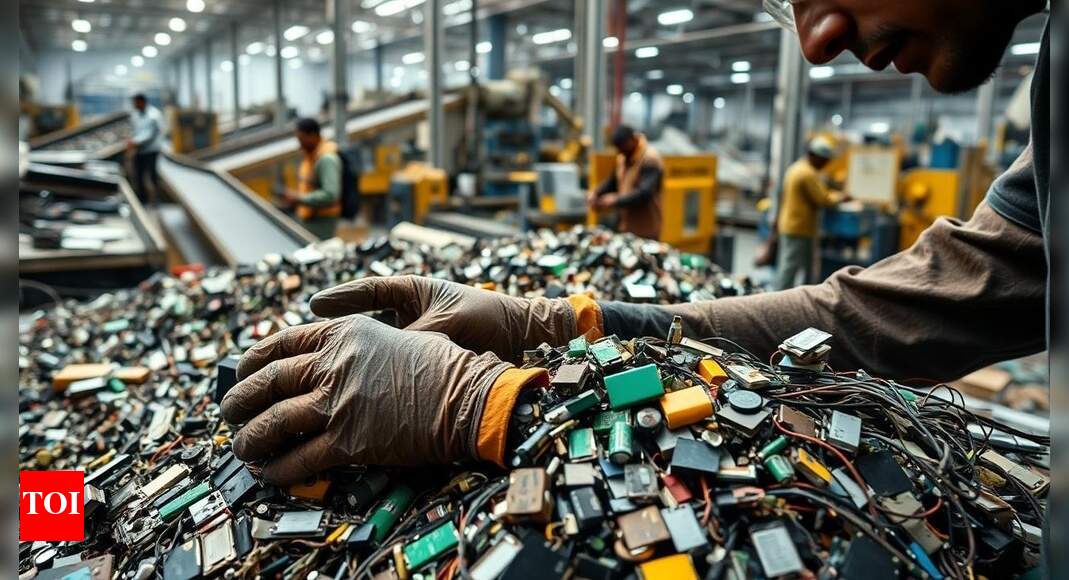
In today’s world, electronic devices are essential, improving our lives and connecting us like never before. While this digital evolution has brought about incredible advancements and conveniences, it also presents the important challenge of managing electronic waste (e-waste). By embracing sustainable solutions and responsible recycling, we can enjoy the benefits of technology while safeguarding the environment for future generations.According to the UN, e-waste volumes are growing five times faster than e-waste recycling, with an 82% jump since 2010. India, the world’s third-largest producer of electronic waste, has seen its e-waste rise significantly over the past five years, from 1.01 million metric tonnes (MT) in 2019-20 to 1.751 million MT in 2023-24.India’s Circular Economy Action Plan demonstrates both challenges and opportunities. Businesses are adapting to regulatory frameworks and financial constraints while responding to changing consumer demands, showcasing their commitment to sustainability and innovation for a brighter future.In this context, business decision makers often ask themselves: How can we reconcile the pressing need to innovate and remain competitive with our equally important need to be environmentally responsible? Thankfully, the answer is not about choosing one or the other. Instead, it lies in reimagining our relationship with technology and embracing an end-to-end approach to sustainability: where resources are valued, products are designed with sustainable materials and waste is minimised.
Here are some steps to help the technology industry reach that goal:
Embrace smarter product design to promote circularity
Product design plays a significant role in reducing waste and thinking about how to reduce production costs in the long-term. A sustainable approach begins with creating guidelines for how components are designed before they go on to form complete systems.Product design dictates how practical it is to reuse and refurbish these components or to harvest recyclable materials at the end of a device’s life. Designing with durability and modularity in mind means that parts can come back through a services network before re-entering the supply chain, to be used to repair and refurbish systems. For customers and consumers, there is the added benefit of being able to purchase these products at a lower price point.For components that cannot be easily reused, designs could focus on easy disassembly paired with clear markings, minimised paintings and coatings and simplified material choice. This makes it easier for the recycling industry to recover more material, more quickly.
Design products with circularity in mind
Information technology is heavily dependent on finite raw materials, including minerals like lithium or cobalt, which are associated with high energy, water consumption and environmental damage during extraction. Many companies design products for easy repair, reuse, and recycling to keep materials in circulation longer and reduce waste. Using recycled and renewable materials can lower the environmental impact of the products and packaging. Every pound of recovered steel, aluminium, plastic, and copper means less material extracted from the earth, supporting sustainability.Demand for alternatives is increasing, particularly as they do not deplete additional natural resources and emit fewer greenhouse gases in their production and during the product life cycle. For example, low-emission aluminium and recycled cobalt are being used in AI PCs. Another alternative material is a bioplastic derived from production of paper , which is used as a new component for technology casings.When we design products, we must design for circularity. So, one of the most immediate initiatives is for the IT design process to operate as a closed-loop model, which keeps products and materials in circulation as long as possible.
Harnessing AI for sustainability: Balancing opportunity with responsibility
AI also presents transformative opportunities to help businesses meet broader sustainability objectives. AI operations contribute 1% of global greenhouse gas emissions, according to the International Energy Agency (IEA), hence making it crucial to ensure that the AI model and infrastructure itself have strong sustainability credentials.The opportunity for leveraging AI as a tool lies in its ability to identify issues more efficiently around sustainability, meaning they can be addressed more promptly. By analysing vast amounts of data from various sources, AI can identify fixes quickly than alternatives. The insights derived are useful for informing strategies that reduce waste across everything from the supply chain itself, through to manufacturing and packaging optimisation.Reducing energy consumption and e-waste within AI requires a multi-faceted approach, including embracing energy-efficient hardware like low-power processors and accelerators, which can significantly shrink carbon footprints. For example, sustainable data centre solutions like storage and servers built with leading liquid and air cooling, emissions tracking and energy efficiency are top of mind. Therefore, consideration about the modular design and upgradeability of AI hardware can minimise the e-waste coming out of the infrastructure needed to power the models.Finally, implementing responsible recycling and disposal practices for outdated components is critical for minimising waste and maximising resource recovery.
Take an end-to-end approach
Because sustainability is now a business imperative, it should be intricately woven through business operations. Responsible practices should be integrated into every facet of the organisation, extending outwards to suppliers, partners and customers. Having clear, internal and external alignment on these goals makes it easier to drive more sustainable materials innovation, pioneer new energy solutions and navigate changing regulatory landscapes.Cross-functional collaboration is key to empowering change within the whole ecosystem; for instance, if it becomes a requirement that products need to be designed with materials innovation at heart, then suppliers are challenged to innovate to meet those specific demands. This end-to-end approach drives more meaningful, widespread change and helps to create a more sustainable ecosystem.While the digital revolution has reshaped our world and created new, exciting possibilities, its environmental impact can’t be ignored, nor can it continue in the same way. The escalating e-waste crisis calls for a shift in the way we approach building and designing new technologies. At this juncture, it’s time to embrace circularity, resource efficiency, and employ longer-term thinking when it comes to technological innovation. By exploring new ways of thinking, businesses can begin shaping a digital future that strives to grow in balance with the environment, creating opportunities for both progress and sustainability.By Indrajit Belgundi, Senior Director and General Manager, Client Solutions Group, Dell Technologies, India
