




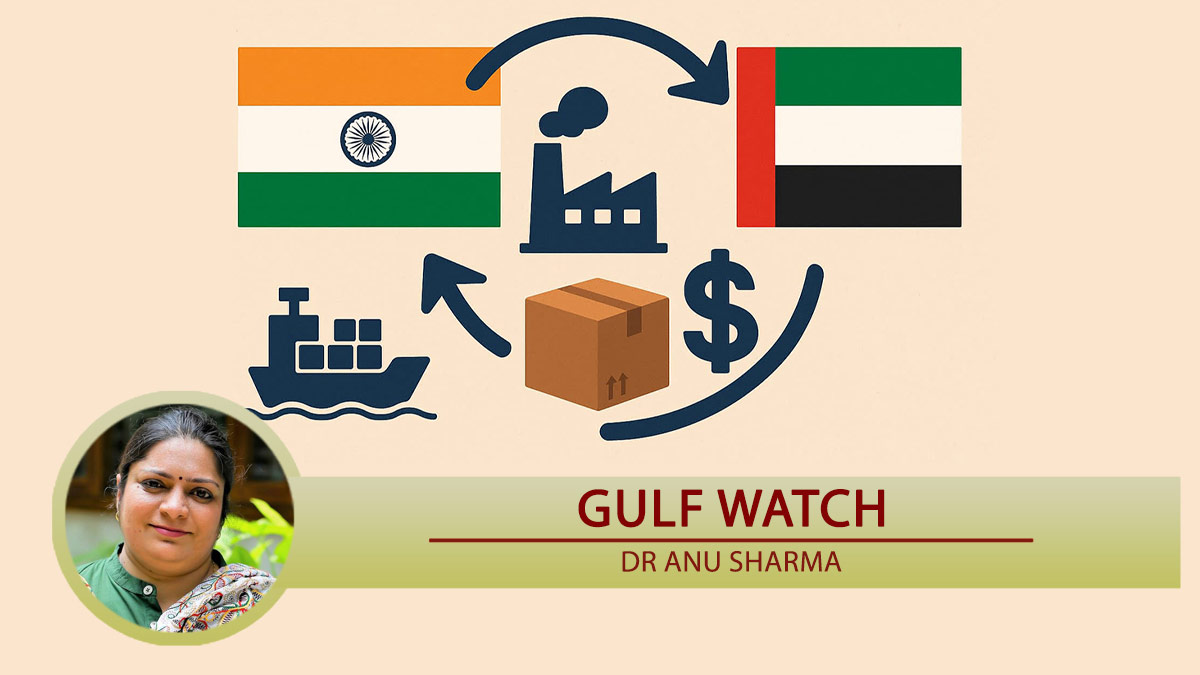
The signing of the Comprehensive Economic Partnership Agreement (CEPA) between India and the United Arab Emirates (UAE) in 2022 marked a pivotal turning point in bilateral economic engagement.
Historically, India’s relationship with the UAE in the past was anchored in energy trade and the large Indian expatriate community living and working in the Emirates. However, through CEPA, this partnership has been redefined so that it is strategically aligned with global supply chains, digital connectivity, and trade facilitation. The agreement has significantly lowered tariffs, reduced regulatory barriers, and created an enabling framework for businesses to scale across borders. During the CEPA implementation period i.e., May 2022 to March 2023, India’s exports to the UAE increased from US$26.2 billion to US$28.5 billion. This is almost an 8.5 per cent year-on-year growth. During the same period, India’s global exports, excluding the UAE, grew at 3.1 per cent. India’s imports from the UAE have grown to US$53.2 billion, demonstrating an annual increase of 18.8 per cent from April 2022 to March 2023. Furthermore, the non-oil imports during the same period grew by 4.1 per cent.
The momentum with which CEPA has induced trade patterns reflect both shared economic complementarities and a mutual recognition that the changing global economic landscape needs resilient, diversified, and flexible supply chain architecture. The significant increase in bilateral trade has been one of the most obvious effects of CEPA. Indian exporters now have more competitive access to the UAE market due to reduction in tariffs and duties on traded items. The deal has also given the UAE new chances to increase its exports and incorporate Indian value chains into its international networks for logistics. As a result, CEPA has established a positive feedback loop whereby the UAE enhances its position as a distribution and transshipment hub while Indian products are able to access newer markets.
Over the last two decades, the UAE has built some of the world’s most advanced logistics infrastructure like ports, free trade zones, airports, and warehousing clusters supported by efficient multimodal transport connectivity. Ports like Jebel Ali, Khalifa Port and Dubai ports serve as regional hubs linking Asia, Africa, and Europe. For India, which has been actively expanding diversified trade corridors beyond East Asian shipping routes, access to the UAE’s connectivity architecture offers a strategic advantage. Goods manufactured in India can reach European, African, and Middle Eastern markets faster and more cost-efficiently through UAE re-export channels. CEPA strengthens this logistical interdependence by streamlining processes and costs.
Another dimension of CEPA is its role in expanding financial and investment integration. The UAE is one of the largest sources of foreign direct investment into India, and CEPA has encouraged Emirati sovereign wealth funds, private equity firms, and industrial investors to increase their exposure in Indian infrastructure, renewable energy, ports, and digital platforms. At the same time, Indian banks, fintech companies, and service sector firms have gained greater operational freedom in the UAE. These linkages reinforce the UAE’s emergence as a financial gateway for Indian firms. CEPA has also strengthened cooperation in emerging technologies and digital trade, and both the governments have emphasised establishing innovation ecosystems, cross-border startups, and digital public infrastructure as core pillars of the partnership. The focus is not merely on goods trade, but on designing intelligent, responsive, and scalable supply and value chain systems.
At the same time, CEPA’s impact can also be influenced by the geopolitical and geo-economic shifts. Global supply chains are undergoing fragmentation, with countries seeking to look for alternate sources for manufacturing hubs. In this, India’s production-linked incentive (PLI) schemes look forward to draw manufacturing closer to home, while the UAE seeks to secure its relevance in an era of energy transition. The agreement also subtly diversifies India’s trade architecture away from China-centric dependence and complements wider connectivity initiatives such as the proposed India–Middle East–Europe Economic Corridor (IMEC).
Overall, CEPA represents more than a trade deal. It is a strategic integration of markets, supply chains, and economic futures. The UAE is not simply a buyer or seller in India’s external trade profile, but it is becoming a logistics, financial, and technological gateway that links Indian production with global consumption. This partnership focuses on supply chain resilience, innovation, and connectivity in a way positioning India and the UAE as key actors in shaping the evolving economic landscape across Asia, Africa, and Europe.
The author is assistant professor, Amity Institute of Defence and Strategic Studies (AIDSS), Amity University, NOIDA.
